
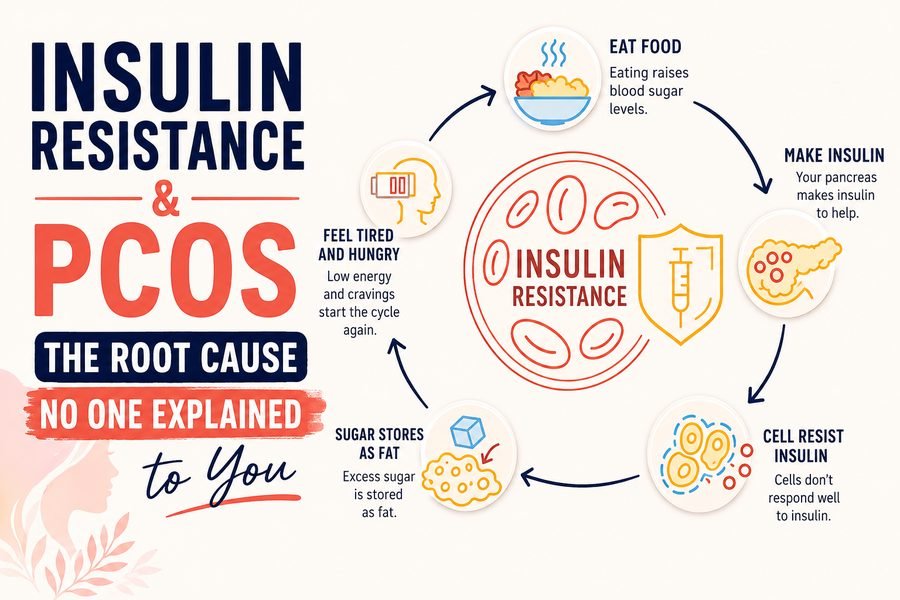
If you've been told you have PCOS and handed little more than a prescription and a vague suggestion to "lose some weight," you're not alone — and you deserve a better explanation. For most women with PCOS, there's a metabolic process running underneath the visible symptoms: insulin resistance. Research suggests it affects somewhere between 50% and 80% of women with PCOS, including many women at a normal weight.
Understanding insulin resistance is often the turning point. Once you see how it connects your irregular cycles, cravings, fatigue, and stubborn weight, your daily choices stop feeling random and start feeling strategic.
What insulin resistance actually is
Insulin is a hormone made by your pancreas. Its main job is simple: after you eat, it helps move glucose (sugar) from your bloodstream into your cells, where it's used for energy.
With insulin resistance, your cells stop responding to insulin as well as they should. Your pancreas compensates by producing more insulin to get the same job done. The result is chronically elevated insulin levels — a state called hyperinsulinemia — even while your blood sugar may still look "normal" on a standard test.
How high insulin drives PCOS symptoms
Elevated insulin isn't just a blood-sugar issue. In PCOS, it interacts directly with your reproductive hormones:
- It raises androgens. High insulin stimulates the ovaries to produce more testosterone and reduces the liver's production of SHBG (the protein that binds excess testosterone). More free testosterone means more acne, facial hair growth, and hair thinning.
- It disrupts ovulation. Elevated androgens and insulin interfere with the hormonal signals needed for an egg to mature and release — hence irregular or missing periods.
- It promotes fat storage and cravings. Insulin is a storage hormone. Chronically high levels make it easier to store fat (especially around the middle) and harder to burn it, while blood sugar swings drive the crash-and-crave cycle many women know too well.
- It drains your energy. When glucose struggles to get into your cells efficiently, fatigue and brain fog often follow.
This is why insulin resistance is often described as a root-level driver of PCOS rather than a side effect. Address it, and many downstream symptoms begin to ease.
Signs worth discussing with your doctor
Insulin resistance doesn't always announce itself, but common clues include: strong cravings for carbs or sugar, energy crashes after meals, weight gain concentrated around your waist, difficulty losing weight despite genuine effort, skin tags, and darkened skin patches at the neck or underarms (acanthosis nigricans).
If several of these sound familiar, ask your healthcare provider about testing — commonly fasting insulin, fasting glucose, HbA1c, or an oral glucose tolerance test. This matters beyond fertility and weight: insulin resistance raises long-term risk for type 2 diabetes and cardiovascular disease, and early action meaningfully changes that trajectory.
Evidence-based first steps to improve insulin sensitivity
1. Build blood-sugar-steady meals
You don't need to cut carbs to zero — you need to change how they arrive. Pairing carbohydrates with protein, fiber, and healthy fat slows glucose absorption and blunts the insulin spike. A practical template: half your plate non-starchy vegetables, a quarter protein, a quarter smart carbs (whole grains, legumes, fruit), plus a thumb of healthy fat.
2. Move after meals — even for 10 minutes
Muscle contractions pull glucose out of the bloodstream without needing much insulin at all. A 10–15 minute walk after your largest meal is one of the highest-return habits for the time it takes.
3. Add strength training
Muscle is your biggest glucose "sink." Two to three strength sessions per week — bodyweight at home counts — improves insulin sensitivity independent of weight loss.
4. Protect your sleep
Even a few nights of short sleep measurably worsens insulin sensitivity in healthy adults. For PCOS, sleep is not a luxury; it's metabolic treatment. Aim for 7–9 hours, and if you snore or wake unrefreshed, ask about sleep apnea screening — it's more common with PCOS.
5. Manage stress like it's medication
Chronic stress elevates cortisol, which raises blood sugar and works against insulin. Ten minutes of anything that genuinely downshifts you — walking, prayer, breathwork, journaling — is a legitimate part of your protocol.
The takeaway
Insulin resistance is not a character flaw and it's not your fault — it's biology, shaped by genetics and environment. But it responds remarkably well to consistent, modest changes. You don't have to overhaul your life this week. Pick one step above, practice it until it's boring, then add the next.
Ready for a structured start? Download the free PCOS Kickstart Guide — it turns this article into a 7-day action plan.